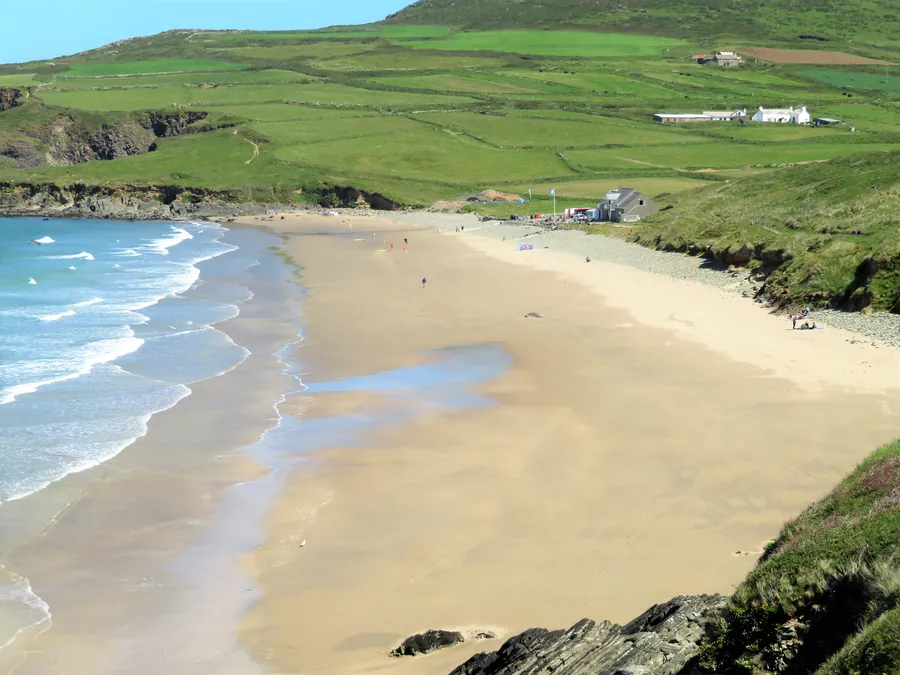
Whitesands Bay — Porth Mawr, “the great cove” — is on the western tip of the St Davids peninsula, three kilometres west of St Davids and about thirty kilometres from Haverfordwest.
It is a Blue Flag beach, it is widely described as the best surfing beach in Pembrokeshire, and it faces Ramsey Island across Ramsey Sound.
A long crescent of pale sand, backed by low dunes and cliffs, with rock pools at either end and caves in the rock at the northern corner.
The water is clear — genuinely so, with the pale sand and the Atlantic light producing the turquoise that appears in every photograph of this beach and is not exaggerated.
Lifeguards patrol in season, and the bathing is described by families as safe, with a gentle shelf and no estuary complications.
Surf: it picks up Atlantic swell directly and works across a range of sizes, with a good beach break. Surf schools and hire operate here through the season, and it is one of the main learning beaches in Wales.
No dogs, in the main season — which for families is part of why it works, and for dog owners means going elsewhere.
Whitesands is the natural start for two of the best walks in Wales.
North to St Davids Head — about 2.5 kilometres of coast path to a rocky headland with an Iron Age promontory fort, the Warrior’s Dyke rampart still visible, ancient field systems, and Coetan Arthur, a Neolithic burial chamber. The view runs to Ramsey, the Bishops and Clerks rocks, and on a clear day the Wicklow Mountains in Ireland.
South to Porthclais and St Non’s, past St Justinian’s, where the Ramsey Island boats and the lifeboat station are.
Carn Llidi, the 181-metre hill behind the beach, is a twenty-minute climb from the coast path and one of the best small viewpoints in Britain.
Choughs on the cliffs, seals in the water and hauled out on Ramsey, gannets from Grassholm passing offshore, and porpoises in the Sound.
Ramsey Island is an RSPB reserve reached by boat from St Justinian’s, ten minutes down the road — a good half-day.
Horses and rabbits graze the common behind the beach, which visitors mention as part of the character of the place.
Free beach. Parking at the beach car park, well regarded and reasonably priced by Pembrokeshire standards, and it fills early on fine days in season.
Facilities: toilets, a café, surf hire and lessons, showers.
Access: the car park is level and adjacent to the beach; there is a slope down to the sand.
Lifeguards: in season only.
Dogs: restricted in the main season — check the signs.
Exposure: it faces west into the Atlantic. It is exceptional in good weather and genuinely wild in bad.
Three kilometres away, and the smallest city in Britain — a cathedral in a hollow below the town, founded on the site of the sixth-century monastery of St David, and the ruined Bishop’s Palace beside it.
The cathedral is free to enter and is one of the great buildings of Wales. It is set below ground level deliberately, so that it could not be seen from the sea by raiders.
Yes — it is generally reckoned the best surfing beach in Pembrokeshire, with surf schools and hire in season.
Yes, with lifeguards in season, clean sand, a gentle shelf and rock pools at both ends.
Not in the main season. Check the signs before travelling.
Yes, a beach car park at a reasonable rate that fills early on fine days.
North to St Davids Head, about 2.5 kilometres, past an Iron Age fort and a Neolithic burial chamber, with Carn Llidi above.