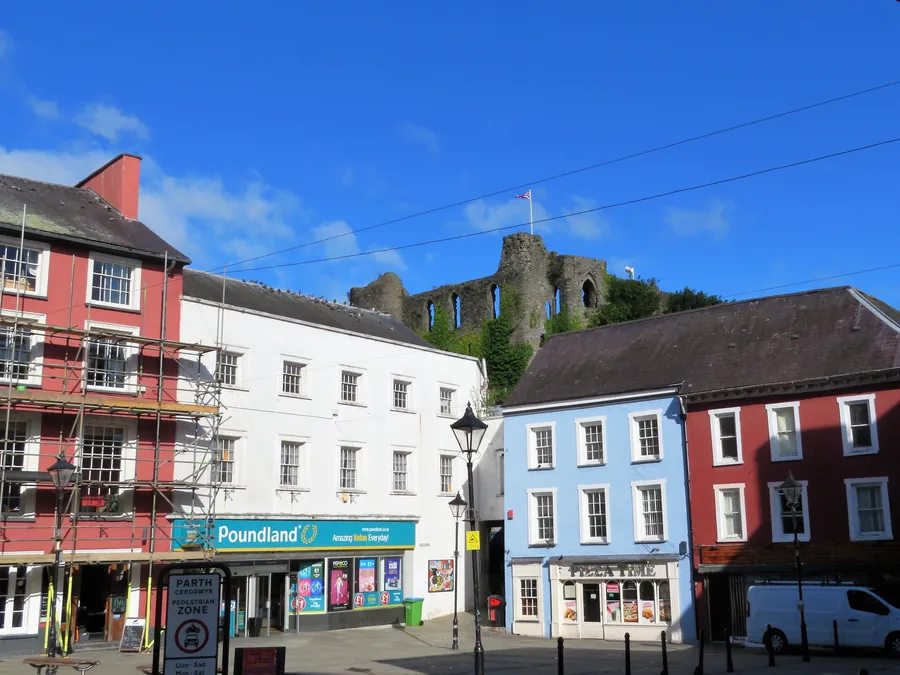
Haverfordwest — Hwlffordd in Welsh, “Harford” in local speech — is the county town of Pembrokeshire and its most populous urban area, 14,596 people in 2011. It is not a resort: it is a market town that became the county’s principal commercial and retail centre, its main road hub and the site of its main hospital. It is where it is because of the river: the lowest bridging point of the Western Cleddau, at the tidal limit, above what was once the lowest fordable point.
That is both the reason to go and the reason to keep expectations in proportion. Staying anywhere in the county you will end up here — for the station, the shops, Withybush hospital — and the old borough repays an hour on foot. The medieval plan is still legible: a castle on one sandstone spur, a High Street climbing another, two old bridges between them, and an Augustinian priory ruin at the southern edge.
It is the closest of the twelve places in this set, 4.0 km straight-line from the centre point the guide measures from; Wikipedia quotes no road distance.
The shape of the town comes from its geology. Two sandstone ridges running east to west, separated by a deep narrow valley, are cut through by the Western Cleddau, leaving two high spurs on the west bank. The castle and the settlement around it stand on the northern one, the core of St Martin’s parish; on the southern one the High Street climbs steeply from the river, the core of St Mary’s. From the foot of each spur an ancient bridge crosses to Prendergast on the east bank: St Martin’s Bridge, the Old Bridge, and St Mary’s Bridge, the New Bridge, built in 1835.
St Mary’s Church stands at the top of the High Street, begun at the end of the 12th century and built in its present Grade I listed form between the 13th and 15th centuries. The castle is recorded as founded in 1100 by the Norman Gilbert de Clare. This research pack holds no visitor reviews for the castle, so nothing here says what it is like to walk round. The riverside, once run down, has been renovated and Bridge Street pedestrianised.
Haverfordwest Priory carries 4.3 from 78 Google reviews. The town museum at the Riverside has 4.1 from 92; the Welsh Spitfire Museum on Bridge Street, 4.4 from 64.
The cinema is where reviewers disagree openly. It holds 4.3 from 384. A visitor in June 2026 wrote, “Such a friendly little cinema, so many showings and lovely staff, in a historic building.” A visitor in July 2026 was blunt: “Cinema one is a bit of a flea pit and smekt really mouldy. The seats were uncomfortable.”
More telling is the rest of the record: the most-reviewed places the pack holds here are not sights but everyday facilities — a leisure centre, a soft play centre, an aquatics shop. This is a town that works for the people who live in it. The leisure centre at St Thomas Green, opened in 2009, sits at 4.3 from 470: a visitor in July 2026 wrote, “The swimming pool is good. The gym is small but the support staff are really nice”, while one in May 2026 gave a single star over the heat — “it’s like a sauna I beg you fix the ac”. Merlins Magic Children’s Play Centre, 4.5 from 399, is the wet-afternoon option for families; a visitor in August 2026 wrote that booking ahead “is the best way to secure your play time here as it can get very busy.”
The name means “ford used by goats”, from the Old English hæfer ford. “West” was added in the 15th century to tell the town apart from Hereford.
Haverfordwest grew first around the castle and St Martin’s Church, then spread into the High Street area and has been western Dyfed’s commercial centre ever since. Its first marcher charter came from William Marshall, 1st Earl of Pembroke, between 1213 and 1219, with the trading privileges of an English borough. At least ten guilds operated, woollen cloth manufacture mattered, and a busy tidal quay worked on the river below the New Bridge. By 1300 the population was probably 4,000 to 5,000.
Then it stopped. The Black Death of 1348 may have halved it; large parts were abandoned, and it was still smaller at the end of the 17th century than in 1300. In 1405 it was burned by the French allies of Owain Glyndwr. In 1545 Henry VIII made it a county corporate to support a campaign against piracy in local waters, one of only two in Wales, and it stayed officially “The Town and County of Haverfordwest” until 1974. It still keeps the right to appoint its own sheriff, and during the Civil War, with Parliamentarian burgesses and Royalist gentry, it changed hands five times.
The most recent chapter is underfoot. In October 2022, archaeologists excavating a medieval priory beneath the old Ocky White building, a department store that closed in 2013, unearthed the remains of 307 people, including children, in a graveyard perhaps in use into the early 18th century.
By road, this is one of the major road hubs of West Wales: the A40 east to Carmarthen and north to Fishguard, the A4076 south to Milford Haven and Pembroke Dock, the A487 northwest to St Davids, plus rural B roads including the B4329 north over the Preseli Mountains to Eglwyswrw.
By rail, the station is on the West Wales Line and is the county’s main one, worked by Transport for Wales, with services to Manchester Piccadilly via Cardiff Central and trains to Milford Haven. It stands in the centre of town, so you can step off a train and onto a bus. The pack’s own files disagree on the distance — 4.0 km in the villages data, 9.4 km to the station in the travel data — so treat both as approximate.
The bus station is beside the Riverside Quay Shopping Centre, with six stops and two coach bays, served by Pembrokeshire County Council, First Cymru, National Express and Richards Brothers. The pack names no route number linking the guide’s centre point to the town. One warning for anyone driving something tall: the Haverfordwest multi-storey and the Scotchwell car park both carry height-restriction barriers that can stop a motorhome.
The village and what is around it, at walking scale.
Open any of them in Google Maps for directions and current opening.
Attractions, prices and availability in Pembrokeshire
These come from GetYourGuide's booking widget, which sets their cookies in your browser. Consent to load it and see the attractions and prices.
Background on Haverfordwest draws on its Wikipedia article, text there being available under CC BY-SA 4.0.