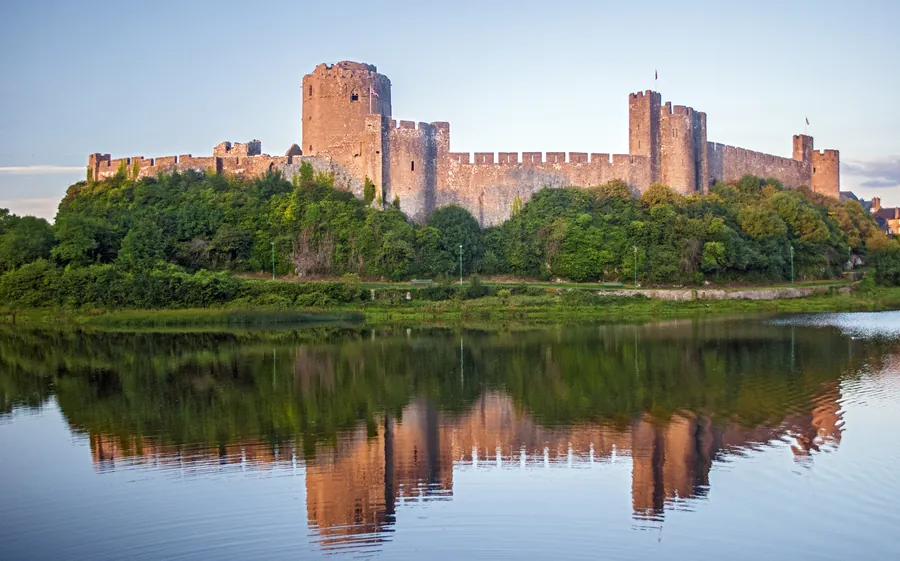
Pembroke Castle stands on a rock promontory almost surrounded by water at the head of the Pembroke River, and it is the most substantial castle in south-west Wales.
Founded in 1093 by Arnulf de Montgomery as an earth-and-timber fortress, it was rebuilt in stone from around 1200 by William Marshal, Earl of Pembroke — reckoned by contemporaries the greatest knight in Europe, regent of England, and one of the most successful men of the Middle Ages.
It is Grade I listed and was heavily and skilfully restored in the early twentieth century, which is why so much of it can be walked.
Marshal’s Great Keep is the outstanding thing here: a cylindrical tower 24 metres high with walls up to six metres thick at the base, and a stone dome over the top — an extremely unusual feature, and one of the reasons the tower has survived intact.
It is four storeys, you can climb to the top, and the view from the parapet takes in the whole town, the estuary and the country beyond.
Round towers were the state of the art in the years around 1200 — no corners to undermine, better deflection of missiles — and Pembroke’s is among the finest in Britain.
On 28 January 1457, in a tower of this castle, Margaret Beaufort — thirteen years old and already widowed — gave birth to a son, Henry Tudor.
Twenty-eight years later he landed at Milford Haven, marched through Wales gathering support, and killed Richard III at Bosworth. As Henry VII he founded the Tudor dynasty.
The Henry VII Tower is identified as the birthplace and is the first thing most visitors go into.
Beneath the castle is a large natural limestone cave, open to the river, reached by a spiral stair from the courtyard.
It was occupied in the Palaeolithic, and there is evidence of use through prehistory into the medieval period, when it served as a store and a boat house — a water gate giving direct access to the river below the walls.
It is an odd place to stand in, and the part of the castle visitors remember.
Pembroke’s owner John Poyer declared for Parliament, then switched sides in 1648. Cromwell himself came to besiege it, and it held for seven weeks until the water supply was cut. Cromwell had the walls slighted, Poyer was shot, and the castle was left ruinous until the twentieth-century restoration.
Free guided tours are run by the castle’s own staff and are, by consistent report, excellent — knowledgeable, entertaining and included in the admission. Take one.
There are towers and wall walks throughout, exhibitions in several of the towers, a Norman hall, and events through the summer including falconry and re-enactment.
Time: two to three hours.
Come before mid-morning. Reviewers who did walked straight in; those who came later queued.
A practical point that visitors pass on: the signed “Castle Parking” leaves you with a steep climb up to the entrance. There is parking on the level nearer the gate — look before you follow the signs.
Admission charged; the guided tours are included.
Facilities: café, shop, toilets.
Access: the courtyard is level; the towers and keep are spiral stairs and the cavern is down a stair.
Getting there: in the middle of Pembroke, about twenty minutes from Haverfordwest. Pembroke station is a short walk.
The future Henry VII, born in the castle on 28 January 1457 to Margaret Beaufort, who was thirteen.
Twenty-four metres high with walls up to six metres thick and a rare stone dome over the top.
Yes — the free guided tours run by castle staff are included in admission and are strongly recommended.
Wogan’s Cavern, a large natural limestone cave beneath the castle, occupied since the Palaeolithic and later used as a store and boat house.
Two to three hours.