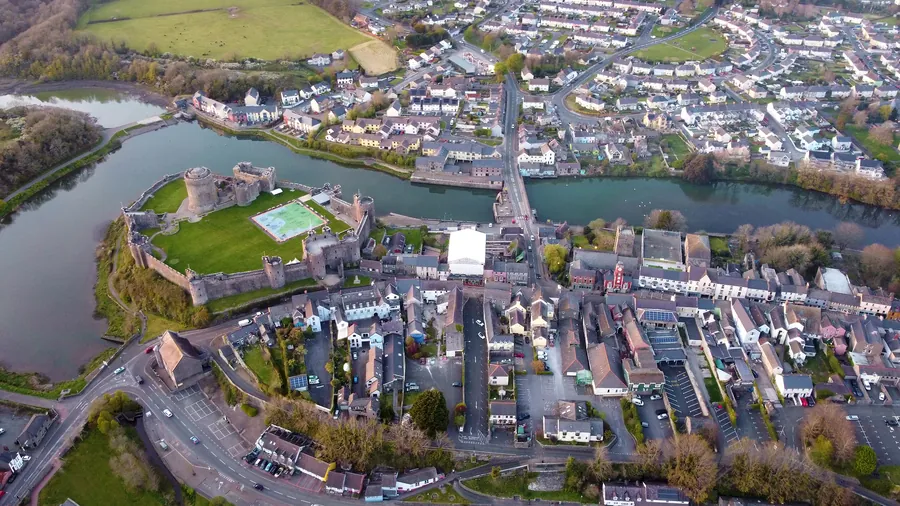
Pembroke is a town of 7,552 people on the south Pembrokeshire limestone peninsula, standing by the estuary of the River Cleddau. In Welsh it is Penfro, after the cantref of that name: pen, ‘head’ or ‘end’, and bro, ‘region’ or ‘land’, read as either ‘Land’s End’ or ‘headland’. The county took its name from the same root.
You go for the castle, and because the town attached to it is still legible as a medieval plan: one walled street, a priory on the hill across the water, and a bridge that doubles as a dam. Pembroke Castle carries 4.7 from 8,254 Google reviews.
Wikipedia puts the town 8 miles (13 km) south of the county town of Haverfordwest; the straight-line distance from the centre point used for this guide is 11.7 km. The ferry port of Pembroke Dock, established in 1814, is 3 miles (4.8 km) northwest, and the two together form a conurbation of 15,890 people.
Pembroke Castle is the substantial remains of a stone medieval fortress founded by the Normans in 1093, on the western tip of the peninsula with water on three sides. It was the seat of the Earls of Pembroke — Gerald de Windsor was the first recorded Constable — and the birthplace of Henry Tudor, who became Henry VII of England. The town was extended and its perimeter walls raised after the castle’s final extension, about 1254.
Reviewers single out the interior and the tours. A visitor in August 2026 wrote, “Free tours of the castle for those that love history. Different events take place over the summer months eg falconry. Good afternoon out with lots of towers to climb and a cave to view.” Another that month, arriving early, found “no clear signage indicating the most appropriate chronological route to take” — so treat it as a warren to be worked through rather than a marked circuit.
Parking has a wrinkle worth knowing. A visitor in July 2026 wrote, “rather than follow the signs for ‘Castle Parking’ and have to walk up the steep slope, there’s a small, slightly cheaper car park almost opposite the castle entrance. Spaces are limited though.”
The town is centred on Main Street, the only street inside the original town walls; the estates towards Pembroke Dock and Lamphey sit outside them. The walls survive on their medieval foundations, much rebuilt over the centuries, and a great many of the town’s original burgage plots survive too, divided by early stone walls of significant national importance. That is why the street reads as it does: long, narrow properties running back from one frontage.
The first stone building in the town was a defensive tower raised on a cliff edge, now known as the Medieval Chapel, at 69a Main Street, with the remains of a great hall to the north. John Wesley used it to preach Methodism in 1764, and in 1866 it became the brewery for the York Tavern, which had briefly been Oliver Cromwell’s headquarters at the end of the Siege of Pembroke during the English Civil War.
This is a working town rather than a resort: Pembroke 21C, founded in 2004 at Foundry House on the Commons, organises the annual Pembroke Festival and the fortnightly farmers’ market, and the rugby club runs the carnival, usually in June.
The main bridge over the River Pembroke also acts as a dam, and it is what holds and constrains the millpond. A tide mill stood on the first bridge here, granted to the Knights Templar in 1199; the last mill building was destroyed by fire in 1956. Paddle West Castle Row Boats, a canoe and kayak tour agency, carries 5.0 from 90 Google reviews.
On the hill across the river stands Monkton, a village included in the community of Pembroke. Monkton Priory was founded in 1098 by Arnulf de Montgomery and granted by him to the Benedictine order; it keeps much of the Norman walling of its nave. Monkton Old Hall, close by the priory church, is regarded as the oldest domestic building in Pembrokeshire and possibly in Wales, and is thought to have been the guesthouse for visitors to the priory. It has 4.8 from 26 Google reviews, another small sample.
Pembroke Museum, a local history museum, has 4.4 from 14 Google reviews, too few to weigh. The bigger collections sit at Pembroke Dock, the grid-plan admiralty town that displaced the older trades — the quarries, slipways and graving dock whose remains still line the river west of the castle. Pembroke Dock Heritage Centre, 4.7 from 381 Google reviews, is the place for anyone interested in the flying boats built and based there in the Second World War. A visitor in June 2026 also noted a “display around the building of the millennium falcon for the Star Wars movies”.
The West Wales Maritime Museum, 4.8 from 109 Google reviews, is volunteer-run, and reviewers are not unanimous: a visitor in July 2026 wrote, “Not a disabled friendly venue, infact disabled people appear not to be welcomed.”
The rail line into the county runs from Cardiff and Swansea via Carmarthen to Haverfordwest and Fishguard, worked by Transport for Wales, daily but thinner at weekends. Haverfordwest is the county’s main station, 9.4 km from the centre point used for this guide, with Pembroke 8 miles (13 km) south of it. Trainline quotes a London-to-Pembroke journey averaging 5h 8m over around 205 miles, though the pack does not say which services reach the town, or how often.
For buses, the pack establishes no service between this guide’s centre point and Pembroke. It records only that the Coastal Bus network meets the railway at four stations, one of them Pembroke Dock, where the Coastal Cruiser (routes 387 and 388) connects — 3 miles (4.8 km) from Pembroke. Bikes cannot be carried on the Coastal Buses inside the national park, so pairing a bus with a bike is not an option.
If you are driving something tall, check before turning in: West Street in Pembroke is one of the car parks named in the pack as carrying a height-restriction barrier, though some barriers come off during the day, with the times on the notice board. Motorhomes may use any council car park but must buy extra tickets where they take more than one space, and sleeping in them overnight is not permitted.
The village and what is around it, at walking scale.
Open any of them in Google Maps for directions and current opening.
Attractions, prices and availability in Pembrokeshire
These come from GetYourGuide's booking widget, which sets their cookies in your browser. Consent to load it and see the attractions and prices.
Background on Pembroke draws on its Wikipedia article, text there being available under CC BY-SA 4.0.